Showing posts with label kids. Show all posts

Tuesday, December 23, 2008

The little donkey

When my daughter was four years old, she came out of her Nursery school proudly proclaiming that she was to be "the little brown donkey" in the Christmas play. Her teacher asked if I could produce a simple costume of tights, hat and jumper within the next few days. "No problem," I cheerfully replied.

Brown was definitely not a fashionable colour in the winter of 1983. I scoured the shops of Portsmouth, I rang around all my friends and r
elations but no brown jumpers, hats or tights were to be found. I contemplated asking the teacher if she could change her script to "a little grey donkey" but instead I bought grey tights and a jumper and dyed them. (To be perfectly honest, I had several failures until I found the right combination of wool and dye, so this was a time-consuming as well as expensive enterprise.) Then I contacted the local Brownie pack and persuaded them to let me have one of their hats. I made a tail and some ears and heaved a sigh of relief that I hadn't let Tanith down. All parents know that feeling at school events! I did think it was rather ungracious of the teacher to look so surprised when she opened the bag, though.

My husband's ship came into port on the morning of the performance and we dashed to Nursery to take our places among the other proud parents. The play began and our little brown donkey came out on cue and performed perfectly as the teacher read a lovely poem:The Donkey

I saw a donkey
One day old,
His head was too big
For his neck to hold:
His legs were shaky
And long and loose
They rocked and staggered
And weren't much use.
He tried to gambol
And frisk a bit,
But he wasn't quite sure
Of the trick of it.
His queer little coat
Was soft and grey
And curled at his neck
In a lovely way.
His face was wistful
And left no doubt
That he felt life needed
Some thinking about.
So he blundered round
In venturesome quest,
And then lay flat
On the ground to rest.
He looked so little
And weak and slim,
I prayed the world
Might be good to him.
Anonymous

Saturday, November 08, 2008

No place quite like home

It must be an age thing: no matter how lovely the surroundings or how scintillating the company, ten days seems to be my limit before I start to feel a desperate need to be within my own familiar walls. So, sad as I was to leave the adorable Millie, it was with a certain relief that I boarded the train at Paddington yesterday and headed back to peaceful and colourful Devon.

The train line from Paddington to Devon passes through some beautiful countryside and it was at its best yesterday with glorious autumn colours seen in clear, bright sunshine. This was a far cry from the snowy scene I woke to on my first morning in London.
I usually make very detailed travel plans but, not knowing how long my daughter would need me following her operation, I had an open return ticket for the train. I didn't expect to have any difficulty in finding a seat on the Paddington to Plymouth train outside the holiday season and strolled nonchalantly down the platform only to discover that every carriage was full. I eventually managed to find a single vacant seat but there were many people standing in the aisles.

My heart sank when I saw that my compartment was occupied by what I judged to be college students
. I love young people, I spent a lifetime working with them, BUT cooped up for two hours in a railway carriage? I misjudged them completely, they were all perfectly well-behaved, mannerly and charming and not English! I am ashamed to admit that a group of 50 or 60 British students would not have provided such pleasant company as these young people, who chatted quietly, shared their magazines and snacks, offered their seats to older passengers, carried bags and helped people off the train and were generally just nice to be around. I don't know who they were or why they were travelling to the South West - perhaps they were heading for Exeter or Plymouth universities? They had North American accents and some were speaking French, so my guess is that they were Canadian. They were certainly a credit to their families and nation. It was like travelling back in time to England before the development of Youth Culture.

I have lots of photographs from my London trip and a book review to write up so there will be more Random Distractions in the next few days.

Wednesday, June 04, 2008

Job satisfaction

I sometimes look with envy at the opportunities available to young people nowadays. They have a great deal more to choose from in terms of study, travel and work. 'In my day' we chose a career (or it chose us), studied for the necessary qualifications and then entered a profession for the next 40 years or so. Yes, we had a certain security in our lives but today's youngsters have far more glamorous prospects, or at least that's how it appears to me.

Still finding my way in my retirement, I wonder how things might have been if I had not been brought up with a great sense of duty and responsibility. What if I'd had the courage to simply pack a bag and set off into the unknown? Well, that's the stuff of dreams and I try to be content with enjoying hearing and reading about the adventures of more free-spirited people.

I like to think that I played a small part in enabling and encouraging a few of my students to go out and do exciting things. It was always my aim, especially in my work with deaf youngsters, to make them feel that they could do things, rather than thinking they should feel handicapped by their deafness. So my job satisfacti
on is great when I hear of their achievements.

Oliver, now aged 27 and looking a little different from when I taught him, has just become the first deaf man to walk to the North Pole, raising £24,000 in sponsorship for charity. His mum emailed me to say how proud she was of his many achievements: he has run marathons, 20Ks and taken part in triathlons in London, Stockholm, Brussels, Paris, Lisbon, Warsaw, Prague, New York and Rome; he'll be representing GB in Turkey in September and is a hopeful to represent the British Deaf in the Para- Olympics. Oliver hasn't only had great success in sport, he got a good degree, runs his own web design company and has done voluntary work in Singapore.

The email from proud mum, Sue, also said: I always remember when you first met Oliver and you said that he was special! And so he was; even at 18 months he was obviously an exceptionally intelligent and determined boy. He's already achieved a great deal and I'll have to be satisfied with my small part in that.

Friday, May 23, 2008

Back soon

I'm off to Dartmoor for a couple of days; to Buckfast Abbey to be precise. Not for a retreat this time; unfortunately, I haven't been able to fit one in yet this year. I am going to spend time with the team of volunteers who will be working on this year's summer camp. It is always inspiring to spend time with such generous and creative people and what a wonderful setting for our planning weekend.

Planning and organising have always been my strong points but I have to question my abilities on this occasion. I didn't realise this would be the Bank Holiday weekend and we'll be driving to Dartmoor along with all the visitors!

I'll be too busy to worry about the weather, which is wet and miserable here at present, but I hope it will be warm and sunny for the rest of you. Happy holiday. Back on Sunday.

Monday, April 21, 2008

Still here!

My thanks to those RD friends who have noticed my absence, there is nothing wrong that an extra pair of hands and ten more hours in the day wouldn't cure! Life has been getting in the way of writing the blog. I seem to be busier now than ever I was before my retirement, or perhaps it is that everything takes longer nowadays.

This is the busiest time of the year for me, when I am organising the summer camp for the diocese. It has been a particularly difficult time because the school we have used for the last 9 summers suddenly increased their charges by 62%. It looked like the end of the camps, which have been running for over 50 years, and I had drafted my letter to the priests of the diocese and arranged a meeting with the bishop to break the news, when the Abbot of Buckfast Abbey came to our rescue and offered us the use of their guest house. So, I have been busy visiting Buckfast, attending meetings and getting out posters and application forms. It is all very exciting but really exhausting and I shall be involved in camp-related activities until the middle of August, so blogging is likely to be sporadic.

In between trips to Plymouth, Buckfast and Exeter I have been getting ready for the first visit of baby Amelia. The MM is off to London tomorrow to fetch her (and her mummy, of course). We will have them to ourselves for a week and then our son-in-law will come to claim them back! My daughter asked me to make a play mat as Millie is now six weeks old (today) and getting ready to learn! I have made a reversible mat so that she won't get bored: side one is some Suzy Spafford 'Suzy's Zoo' fabric and the reverse is the monix attempt at appliqué animals. I am expecting baby Amelia to know all the animal names and sounds by the end of the week.


I have managed to read my favourite blogs even though I've had no time to write anything myself. This post by D on 60goingon16 about '60s humour, including a clip of Peter Cook and Dudley Moore, had me laughing all the way down the M5!

I'm adding lots of labels to this post to make up for my poor output!

PS Latest on 'The Enchanted April' - Tattytiara hasn't been in touch yet to claim her book prize. I'll wait a few more days and then draw another name out of the hat if I don't hear from her.

Monday, October 15, 2007

Living Simply

The theme for our summer camp this year was taken from the Cafod LiveSimply campaign. A team of volunteer helpers lived on campus for a week with 47 youngsters, playing, praying and having fun while living out the principles of the three Ss of the campaign: living Simply, Sustainably and in Solidarity with the poor.


All the activities were planned with these principles in mind. The leaders ensured that all the resources they used were recycled or fairly traded goods. The food was, as far as possible, locally sourced. The tuckshop sold only FairTrade chocolates and locally grown fruit. The youngsters really entered into the spirit of the campaign, ensuring they didn't waste food, water or electricity and compared their lives with those of their peers in other parts of the world.


It was interesting for us to find at the end of the week that this was rated by the youngsters as the best camp ever! They all made pledges to try to live simply when they got home. Here are a few:


Sunday, October 07, 2007

Almost caught!

I almost choked on my muesli this morning as I watched the BBC news. There was Bill Turnbull interviewing a child psychologist and an articulate mother about a campaign by The Happy Endings Foundation to have 'bad' books banned from schools and libraries. There was a serious discussion about the value of exposing children to 'real life' situations and the dangers of wrapping the little darlings in cotton wool.

I rushed to find out more about the Happy Endings Foundation and discovered this on the Norwich Evening News website:

A crusading mother-of-three has made it her mission to ensure children grow up hearing of only the good things in life. Norwich woman Clare Hughes is spearheading the eastern arm of a new national campaign to put a stop to children's books that don't have a happy ending.The 42-year-old has been appointed head of the Happy Endings Foundation's East of England Cheering Committee, which urges parents to only let their children read books with happy endings.
The group was set up after its founder, Adrienne Small, read the first book in the series A Series of Unfortunate Events by Lemony Snicket to her daughter. She said the books caused her daughter to take a more negative approach to life, which only got worse when she subsequently read all 13 books in the series.
Mrs Hughes, whose children are 13, 12 and nine, said: “I've seen the way my children respond to news that goes on in real life, whether that be the disappearance of a child, like Madeleine McCann, or bombings, and that gives them enough nightmares.“Books should give them a sense of good triumphing over evil and let them be rest assured that the goodies will come out on top.”“It's about encouraging children to read books with positive values. Look at Charlie and the Chocolate Factory, there are some unpleasant characters, but Charlie wins out in the end. That's the type of book we support.”

The most worrying aspect of the campaign appeared to be this:

As part of the campaign, letters have been sent out to school libraries
asking them to remove Lemony Snicket books from the shelves and HEF are holding a number of activities, such as Bad Book Bonfires, where they are encouraging people on Guy Fawkes's Night to make their bonfires from “bad books”. Other reads on their “bad book” list include Villette by Charlotte Bronte, The Wide Sargasso Sea by Jeah Rhys, The Little Mermaid by Hans Christian Anderson and Shockheaded Peter by Heinrich Hoffman.


Fortunately, before my rage led me into further folly, I discovered something the BBC researchers had failed to uncover - the whole thing was a hoax! The small print at the bottom of the Foundation's web page reads:

“Disclaimer: Most characters appearing in this work are fictitious. Any resemblance to real persons, living, dead, or half dead, is purely coincidental. None of the non-fictitious people, places or things named in this website were harmed during the creation of the site. We’re not sure if the Loch Ness monster is fictitious or non-fictitious, you decide. We would like to state that some of the books recommended on this site are very good reads, particularly Winnie-the-Pooh. However, we would NOT recommend monster hunting at Loch Ness as a happy day out because a) it rains a lot in north Scotland and b) as previously stated, we don’t know if there is actually a monster to hunt. However, if you like logs then Loch Ness is a fine place to go log hunting.”

And, according to another site I found, the project is the work of the advertising agency which handles the Lemony Snicket books. Well, they got a huge amount of free publicity from the BBC and the national newspapers. The last time the nation was fooled so well was by the Swiss spaghetti harvest on 1st April 1957.

Sunday, September 16, 2007

Are we failing our boys?

The current presenter of my favourite Sunday morning radio programme, A Point of View, is American journalist Tim Egan. This morning he addressed the thorny subject of boys in secondary education; he has a personal interest, being the father of a 17 year old. The state of our schools and the behaviour of young people is never far from the headlines here, so it was a relief, in a way, to hear that it is not a uniquely British problem.

For fourth grade read Year 4 and for 12th grade read sixth form, and the following could apply equally to English students:

"At fourth grade, the boys are as smart as girls, judging by the inexact measurement of test scores. In maths and science, fourth graders in the US rank near the top of all students in the world. By eighth grade, they're in the middle. And by 12th grade - senior year in high school - American students are near the bottom in maths and science."

The concerns are the same on both sides of the Atlantic:


The average is dragged down for one big reason - the boys. They fall through the floor. And the question is did we fail them, as parents? Or did our system fail them?

Egan's article is not the usual judgemental piece we expect of journalists, critical of teachers, parents and the youngsters themselves. He observes with the insight of a sympathetic parent:

This summer I was strolling through Boston at midnight with friends, when we came upon thousands of people, many of them looking to be about age 12 or 13, in a huge, excited line waiting to get the latest Harry Potter book. The buzz, the energy in the streets was extraordinary. All these kids, jostling and bouncing off each other, talking excitedly about - a book. Waiting for hours... to read.
For a 12-year-old boy, it's cool to be smart. It's cool to read. It's cool to be a nerd. But then what happens? By age 17, the boys, many of them, would never be caught dead around something "sooo yesterday" as a printed page from a bound volume. Sure, they're forced to read, for school, but that's a different matter.
So, then they go off to college, where the girls far outnumber them. Or they drop out. And they never spend another day in school and -- sad to say -- they're doomed, by the law of averages. For students who never go to college will earn only about $25,000 (£12,500) a year - barely above the poverty line for someone trying to support a family.
But look at them now, age 17, senior year. All that confidence, even with the mumbling, the texting, the grunting, the sniffing. So much tomorrow in their faces. Ah, but it's surface, in my experience. They have outside swagger, these boys, but inside - they're unsure of themselves.

Does he offer any answers? He refers to a speech given by Bill Gates to a National Governors Conference about two years ago, in which he advocated a complete rethinking of our attitude to teenagers:

After the Gates speech, a number of governors around the US held town hall meetings on rethinking the teenager, especially in that senior year. A new
school in California, called High Tech High, was cited as a role model. There, boys aged 16 and 17 said it was the only place where they felt that being smart was cool.
Bill Gates says the problem is that high school was designed for 50 years ago. Nobody would use a 50-year-old mainframe computer, he says, in his inevitable metaphor of choice. But forget about 50 years, many educators and child psychologists say our system is dated by a century or more.
For starters, why do high school students get summers off? This is a relic of the old agrarian age, when boys were needed in the fields throughout the summer and into the harvest. A hundred years ago, one in three jobs in the US was still tied to agriculture. But today it's barely 1%.

Egan acknowledges that there are no easy, one-stop solutions. The problems in the States are the same as ours, and probably the same throughout the western world: a combination of changing family values, outmoded education systems and serious underfunding:

Another question: Should they drive? In all but a few of the states, a driver's licence can be had at age 16. What follows is perhaps the most dangerous year in a teenager's life, especially that of a boy. This year about 6,000 teenagers will die in car accidents in the US - that's more than 50% higher than the death toll among American troops in Iraq over the last four years. In most of Europe, the age is older, and the death rate is far lower.

What to do? In 2005, First Lady Laura Bush started an initiative on boys, an attempt to figure out why - and how - we fail them. It was supposed to be a three-year initiative, pulling together all the experts. But it never went anywhere, after some initial meetings. And maybe that's because we cannot rethink the teenager by wishful thinking from the executive branch of government.

Bill Gates is more direct - investing nearly $2bn (£1bn) to encourage new high schools and to reform existing ones. Now I know, watching a teenage boy over the course of say, a single hour, that it is very difficult for them to stay focused on any one task. Our son has his driver's license. I tell him no texting, no mobile phone conversations, no distractions while driving a 2,000lb vehicle through the
streets. And certainly, no drinking. Sure dad, he says. I'll behave. Just like you did. And here's where parents - mostly baby boomer parents - trip up. We tell the boys to do as I say, not as I did. We know from experience, but it's painful experience, and it can make us look like hypocrites. When I was 17, I lost my two best friends - two guys I had known since grade school - to car accidents. One was driving home late on a Saturday night after drinking a couple beers. The other fell asleep at the wheel. It haunts me still, those deaths.

That popular book, The Dangerous Book for Boys, has become quite the draw for people asking these questions. There is nothing really dangerous about the book, despite the
title. It is a compendium of all the adventurous things that boys like to do. The authors say that boys are naturally drawn to risk. They portray the kind of risk that seems so retro, so harmless - playing in trees, chasing each other on bikes,Tom Sawyer stuff. That world is gone for boys now in their last year
of high school. Their minds may still be Tom Sawyer, but their bodies are men. We used to have rituals for passing on the baton of life, from one stage to the other. Manhood rituals. Knighthood. Bar Mitzvahs. They were formalised in warrior cultures, and then in the military, or church, or in a tribal circle. Now, for the modern urban
family, the choices are limited. Give them the car keys and sigh? Take them to the mountains for a weekend of bonding around a campfire? It's not enough. Perhaps rethinking the teen, in the end, is just that - with considerable anxiety.

You hope their minds, their souls, their hearts catch up to that newly deep voice. You hope.

No solutions then, but an intelligent and thoughtful approach to the subject for a change. Read the full article here.

Sunday, August 26, 2007

Yobs and chavs

In commenting on my Let's hear it for the good kids post, Peter has set me another poser to address:

"I have a question. We hear a great deal over here about crime and yobs and chavs and the estate culture, etc. Brit always said it was overblown, but there is no doubt your media is full of it. Dalrymple is always going on about the "underclass". My question is, do you see this as limited to such a class (dysfunctional, unemployable)or is it an increasing problem in what used to be known as the "working class" too? Is there still a large, hardy, moralistic class doing the hard work more or less responsibly or are more and more of them being attracted to drunken punch-ups in town centres?"

I begin by agreeing with Brit, that it is overblown. The reports we see in the press would not make the headlines unless they were startling exceptions to our everyday experience. Unfortunately, such reporting is counter-productive in two ways: it presents a false image to young people of what they are expected to be doing out of sight of their parents, and it stirs up fear in older people who then avoid going into certain areas in the evening. If we were all out and about, walking in the parks and town centres, I'm sure much of the poor behaviour just wouldn't happen.

So, the media has to bear some responsibility for the current situation but it is not a simple, single-cause problem, nor is it new. A common theme in my posts is the fallacy of the idea of a 'golden age' in education, moral standards, social behaviour or anything else. We only have to look at our literature and social history books to find accounts of young men (sometimes girls) defying the norms of behaviour set by their parents. The seventeenth century had its 'roaring boys' and the eighteenth century had 'mohocks' and 'young bloods', gangs of wealthy young men who roamed the streets of London: "They put an old woman into a hogshead, and rolled her down a hill; they cut off some noses, others' hands, and several barbarous tricks, without any provocation. They are said to be young gentlemen; they never take any money from any." (Wentworth Papers)

Outrageous fashion and flouting of convention were the hallmarks of the nineteenth century 'dandies' and the twentieth century 'flappers.' These, again, were the young members of the upper middle and aristocratic classes. I suppose the lower classes were too hard at work to indulge in such behaviour; the change seems to have occurred after WWII, when the term 'teen-ager' came into use and a whole youth subculture developed. I can remember the 'teddy boys' of the 50s with their drainpipe trousers, suede shoes and greased hair; for the most part, they were just flexing their fashion muscles but in some places they were little more than thugs and were involved in the race riots of 1958.

In the 60s we had Mods and Rockers. This generation of working class youngsters had more money to spend and more leisure time. They bought leather jackets and motorbikes and followed rock bands if they were Rockers and bought Italian suits and motor scooters and followed The Who if they were Mods. I think they just attacked each other and not the general public.

There is no doubt that there has been a change in the youth subculture in recent years largely due, I think, to the use of alcohol and a lack of adult supervision. City centres, town centres and now even our village centre are full of drunken teenagers on Friday and Saturday nights. Pub staff and nightclub managers could reduce this problem at a stroke if they would refuse to serve drinks to those who are obviously drunk. The massive expenditure on police units and first aid posts to deal with the problems after midnight might be better used on a police presence earlier in the evening, ensuring that the existing laws on serving alcohol are enforced. I won't mention the farcical extended-licence law.

The 'estate culture' is something else. Vulnerable, unsupervised children are prey to drug-pushers and this seems to be where the gang culture is growing. Boys as young as eleven and twelve may be recruited and some have started to carry knives to protect themselves or to bully others. We are seeing the effect of this bullying in the reluctance of the people of Liverpool to co-operate with the police in tracking down the killer of Rhys Jones. This appears to be a growing problem but it is not typical teenage behaviour in Britain.

Who is to blame and what can be done? Family life isn't what it was, or is it? This is what a Flapper had to say to her parents in the 1920s:

"It must begin with individuals. Parents, study your children. Talk to them more intimately. Respect their right to a point of view. Be so understanding and sympathetic that they will turn to you naturally and trustfully with their glowing joys or with their heartaches and tragedies. Youth has many of the latter because Youth takes itself so seriously. And so often the wounds go unconfessed, and, instead of gradually healing, become more and more gnawing through suppression until of necessity relief is sought in some way which is not always for the best."

On the whole, good parents produce well-behaved children, who grow into well-balanced adults. Schools have an important role but they do not produce badly behaved children, they just have to deal with them. Governments have a responsibilty to provide a healthy economy so that families can work and earn enough to allow parents time to spend with their children. Fact: there are far more good parents, good kids and good schools than there are bad ones.

What won't solve the problem is yet more legislation.

Friday, August 24, 2007

Let's hear it for the good kids

Today's papers are, understandably, full of accounts of the tragic death of 11 year old Rhys Jones. Alongside the factual and the emotional headlines, we have the usual knee-jerk cries for yet more legislation to control our young people. It is too easy to whip up a frenzy of anger and fear, to portray a generation of disaffected knife or gun-toting gang members. I confess to having been temporarily drawn into that distorted view when the first reports of knife crime were made. I feared for the safety of my daughter, teaching in a North London school until she laughed at my concerns. The inter-school alarm system they had was not, as I had read, to warn of teenage riots but to warn of potential drug pushers at school gates. She told me that she had no fear for her safety, that at the first hint of trouble her pupils would be hiding behind her skirts, not threatening her.

If we keep on telling teenagers they are hooligans, we could make them feel they should live up to their reputation. So, why don't we calm down and look for positive stories? Let's see how a little acknowledgement and praise works. Here's my story of some typical local boys:
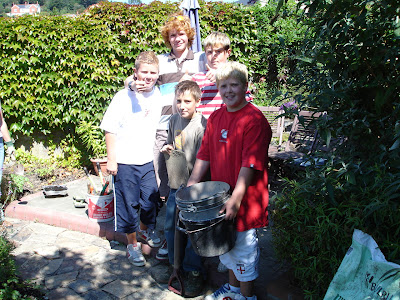
The next stage of my garden development was to have been the rockery but the wet weather has delayed the work. As we are enjoying a brief dry spell, I thought I could get some topsoil up to the top of the rockery and plant the jasmine, passion flowers and clematis which have been sitting in pots for weeks. Have you any idea how heavy topsoil becomes when it has been left in torrential rain? I could only manage to lift about one twentieth of a bag at a time and I had six bags to shift. The MM is, typically, away watching cricket matches and I couldn't think of anyone who owed me that kind of favour, so I went out and stopped a 13 year old boy who was skateboarding past the house and asked if he had any friends who would like to earn a little pocket money lifting heavy buckets of soil. He said he would talk to his friends and maybe see me in half an hour.


In fact it was one and a half hours later that the doorbell rang and five grinning boys told me they were reporting for work. Here they are, being supervised by my gardener, Becky, who had feared that she and I would be spending several days on the task. The lads were so enthusiastic that they carried on and did a bit of weeding too.


When they had finished, I asked what they thought their labours had been worth and it transpired that they did not expect to be paid anything. One boy said, "I only came to see if I was able to do it." I did pay them, quite handsomely I think, but I had the impression that the invitation and the praise meant more to them.


Here they are: the good guys.

Saturday, January 20, 2007

Children's parties US style

There is growing concern in the US, apparently, about the escalating cost of children's birthday parties. Forget ice-cream, cake and a clown; no more passing parcels, musical chairs and spin-the-bottle. Today's children demand to be entertained by international celebrities and to take home a party bag containing electronic gear.

From the Daily Telegraph yesterday:

Mega-rich parents often set a spendthrift example - a Long Island
businessman, David Brooks, spent $10 million on his 13-year-old daughter's party,
which included performances by the rock group Aerosmith and the rapper 50
Cent, together with $10,000 party bags for the teenage guests.

Where the US leads, the UK tends to follow albeit in an appropriately scaled-down fashion. The extravagance here only extends to around £50,000 for the most 'fashionable' parties.

_______________________________

Every summer I organise camps for 8 to 12 year olds. They are inexpensive, so that we can take children from all economic backgrounds. The rules are simple, but strictly adhered to: no mobile phones or electronic games and no TV. The first twenty-four hours are tough because the children are used to being entertained rather than thinking up their own games; they crave constant visual and auditory stimulation. We take all that away and provide quiet and space, routine and discipline, art and craft materials, musical instruments, bats, balls and skipping ropes.

By the end of Day Two, the kids have formed themselves into friendship groups and 'working' groups, which are not necessarily the same. We adults watch as leaders emerge, teamwork and co-operation develop, imagination and creativity flourish. There is rarely any bullying and I have never seen any snobbery - friendships develop among children from very different social backgrounds.

When the parents come to collect their children at the end of the week, they are amazed at the displays of artwork, music, dance and drama. They are even more amazed that their offspring have survived without TV and electronic games. We get many letters afterwards, saying the youngsters had more fun than on any holiday, and many come back year after year. It is interesting though, that even those coming back for the third or fourth year have that painful first day when they miss the trappings of the 21st century!

I know - it sounds simplistic and idealistic. But it works and it costs almost nothing!

Saturday, September 16, 2006

Unfit kids

I watched with dismay the first episode of Channel 4's programme 'Ian Wright's Unfit Kids.' What an example of well-meant, blundering amateurism. I have no doubt that Ian Wright genuinely wants to promote fitness in youngsters but this programme has taken on a group with complex physical, social and emotional problems and one well-intentioned former footballer is not going to solve those problems in six months. In fact, he is far more likely to do a great deal of harm.

I am reliably informed, by an inside source at one of the schools involved in the programme, that the initial brief was to work with a group of youngsters who persistently refuse to join in sports activities. The intention was to motivate them to enjoy sport and to improve their fitness. For reasons not disclosed in the programme, Ian Wright ended up with only one youngster fitting the original criteria and seven others who are seriously overweight.

Instead of a group consisting of kids who don't like sport, or who hate teamwork, are plain lazy or just won't co-operate in any way in school - challenges enough for anyone! - Ian Wright has ended up with individuals with a wide range of problems including poor nutrition, low self-esteem, a history of failure, social exclusionand possible health problems, to mention only the obvious.

We saw within the first few minutes of the first episode that there was no strategic plan, no funding and no expert support available. The vulnerability of the children and their parents was obvious. It was also obvious that there is little hope that the series will end with a group of happy, well-adjusted, fit and slimmed-down youngsters. So what is Channel 4 to do? Scrap the venture or exploit those vulnerable people?

What must it have been like for those children to go into school on Wednesday morning, their weight now public knowledge, their homes exposed, their weaknesses revealed? I think the programme's title should be changed to 'Unfit Adults.'