My posts about Devon usually boast photos of sandy beaches, stunning coastline and sun-drenched cottage gardens. Unfortunately, like much of the rest of southern England, we are having a tough winter and we are all wondering if things will ever be the same again.
The wet weather started in December and, apart from a few brief bright spells, it has gone on and on and on with no end in sight. As well as the never-ending rain, we are currently experiencing storms and high tides here on the coast. Our beaches are being swept away, our rail link to the rest of England has been cut off, seafront homes and businesses are being destroyed while further inland, farms and villages are suffering badly. Here is a clip from an ITV news report showing some of the damage:
I wonder if Ikea make a flatpack ark?
Sunday, February 09, 2014


Thursday, January 09, 2014
January reflections
Belated New Year greetings to all. I had intended posting this piece earlier but I saw that my son had introduced his New Year post on The Dabbler with allusions to Janus, just as was intending to do here. Now that his post is history, I've decided to use mine!

 I'm going to invent a new word and describe the opening of a new diary as Janusistic. I sit with last year's diary and transfer significant dates to the new one, then I take out all the appointment cards that I've kept in the back of the old one while waiting for the new one to arrive. What an opportunity to practise saying, "Goodness, is it so long since ......." at the same time, recognising that the teeth, feet, eyes and ears are all another year older!
Filling in the dental appointments is the task I like least. I think of all the money I pay to be tortured! Not by my lovely dentist, I must hasten to say, but by the hygienist who offers spurious excuses for the agonising scraping and poking at my poor ivories and gums; it takes days for me to recover. On a brighter note, the waiting room always has tubs of sample tubes of different toothpastes. I like to pick up a few as they are the perfect size for overnight or weekend visits. One such sample intrigued me: the manufacturer noted the herbal ingredients and stated that many people found that, after using the toothpaste for14 days, they quite liked it. I don't know which PR firm they employ.

Many people find January a gloomy and depressing month but I like the opportunity to look back and towards the future at the same time. The New Year isn't so much a time for making Resolutions, (pie-crust promises as Mary Poppins might say), as for getting things into perspective.
For many years, January was a sad month for us: my father died on January second; a few years later my younger sister, barely thirty years old, died on January twenty-third and, just a few years later, my mother died on January twenty-fourth. I used to dread the coming of January with its feelings of loss and grief and I couldn't bear New Year celebrations. As time has passed, though, happy memories have taken precedence and I find it is good to have this specific time in the year when I look back on the lives of my parents and sister and recall all the positive aspects of their lives. My brother and older sister and I share funny stories from our childhood - there is nothing like laughter to put things into perspective: it overwhelms sadness just as light overwhelms darkness.
I always think of Janus on January 23rd. Not only is it the anniversary of my sister's death but also the day on which I twice had life-saving surgery, the same day in consecutive years. As anyone who is "in remission" knows, there is always an element of fear as check-ups and anniversaries approach but the image of Janus reminds me that each year I have further to look back on; years filled now with precious memories. Hope, like laughter, is a powerful antidote to gloom.
-----------------------------------
Filling in the dental appointments is the task I like least. I think of all the money I pay to be tortured! Not by my lovely dentist, I must hasten to say, but by the hygienist who offers spurious excuses for the agonising scraping and poking at my poor ivories and gums; it takes days for me to recover. On a brighter note, the waiting room always has tubs of sample tubes of different toothpastes. I like to pick up a few as they are the perfect size for overnight or weekend visits. One such sample intrigued me: the manufacturer noted the herbal ingredients and stated that many people found that, after using the toothpaste for14 days, they quite liked it. I don't know which PR firm they employ.
--------------------------------------
It was 6 January 1989 when we moved from Hampshire to Devon. Looking back over the 25 years that we have lived in this house, we see many changes. We arrived here with a young son and daughter, they are now grown with children of their own. The quiet village has grown into a busy thoroughfare, taking traffic to the beaches. We have been talking about leaving for several years and perhaps 2014 will see that happen. The great de-clutter has begun! Grandchildren Millie and Ben are very keen to have us move close to them, in fact so close that they want to build a house for us in their garden. They spent hours designing the ideal home for us:
It is a house with many doors and windows. Ben chose the shapes and colours, Millie did the drawing. There are enough rooms for us to entertain everyone we know. I can't wait to get there!
--------------------------------------
I know that the weather is a real problem for many people, this January but I hope that the freezing conditions in US and the floods in UK will soon be over and that everyone has a good year ahead.
Sunday, December 22, 2013
Christmas Greetings
Very best wishes for Christmas and the New Year to all! I hope you will enjoy this selection of carols from King's College, Cambridge.
Tuesday, December 10, 2013
Surprise!
I couldn't let the year end without one last attempt to write something here. Life does have a tendency to get in the way of reading and writing blogs these days. My fingers have been busy making and baking rather than typing.
My mother and two sisters were really good at creating lovely things to wear, while I spent hours unpicking my uneven seams and dipping hems. My attempts usually ended in the dustbin or rag bag. It has taken the advent of grandchildren to get me to take up a needle again and nowadays I even use a sewing machine!
It all began with little quilts for cots and then aprons for toddlers and now I am responding to requests for dressing up outfits. This year the children will be snow leopards and cheetahs in these outfits:
 I'm sure they will look better with children inside.
Then they all needed sweaters and hats; here are just a few:

and Ben wants to be a Jedi knight so I made him a robe:

One of my friends had enough confidence in my new-found sewing skills to commission some aprons to give as Christmas presents for her teenage daughter and friends. Cupcakes galore and a smarter one for herself.

I've made candles and cakes, mince pies and cookies and today will be chocolate-making day. How I wish my mother could see me now! Each success I've had has boosted my confidence and I think I would probably have a go at any new challenge now. It is lovely to surprise others and even better to surprise myself. Perhaps my next challenge should be to get back to blogging regularly in the New Year, now that would surprise you!
My mother and two sisters were really good at creating lovely things to wear, while I spent hours unpicking my uneven seams and dipping hems. My attempts usually ended in the dustbin or rag bag. It has taken the advent of grandchildren to get me to take up a needle again and nowadays I even use a sewing machine!
It all began with little quilts for cots and then aprons for toddlers and now I am responding to requests for dressing up outfits. This year the children will be snow leopards and cheetahs in these outfits:
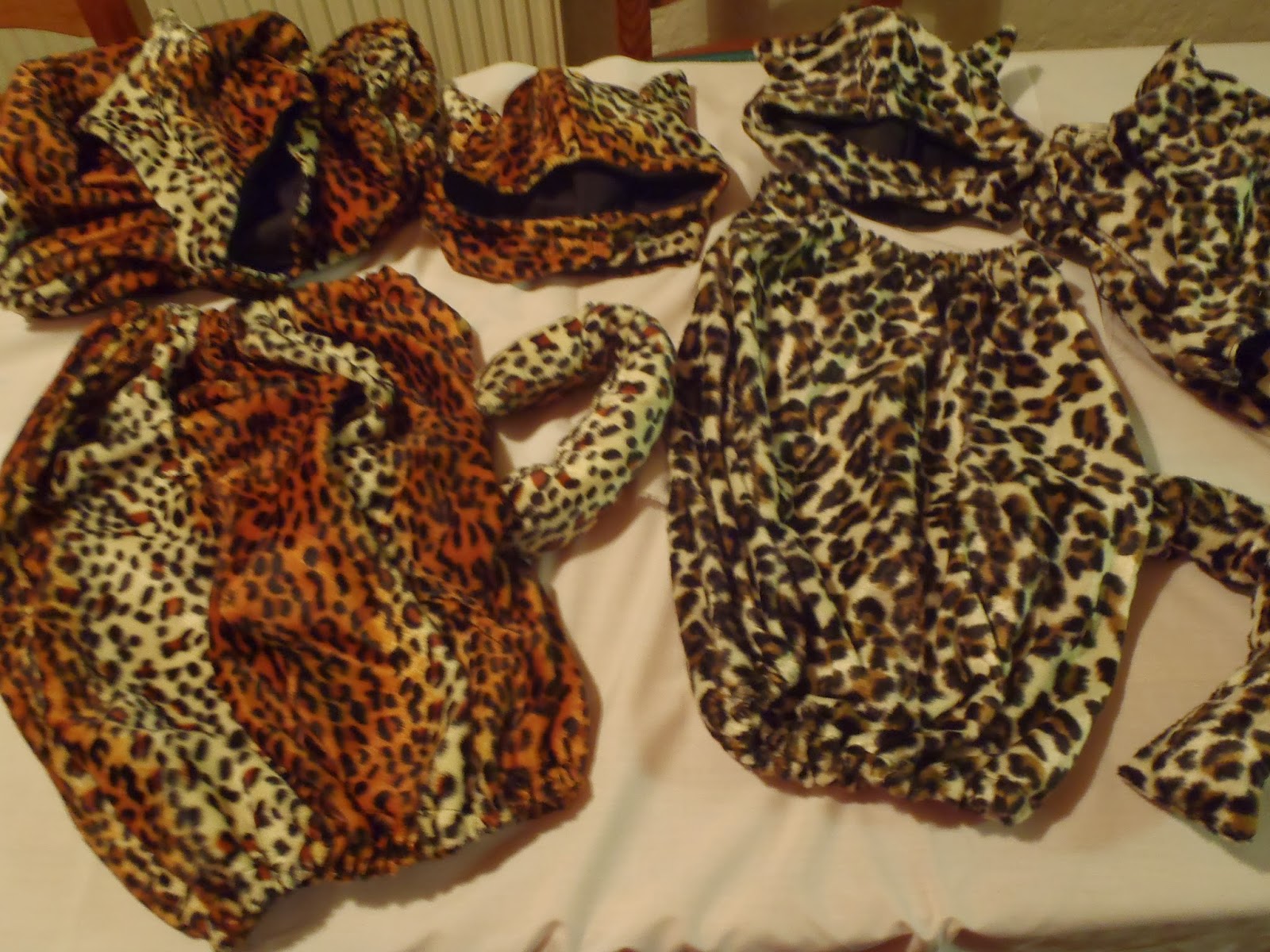
Then they all needed sweaters and hats; here are just a few:

and Ben wants to be a Jedi knight so I made him a robe:

One of my friends had enough confidence in my new-found sewing skills to commission some aprons to give as Christmas presents for her teenage daughter and friends. Cupcakes galore and a smarter one for herself.

I've made candles and cakes, mince pies and cookies and today will be chocolate-making day. How I wish my mother could see me now! Each success I've had has boosted my confidence and I think I would probably have a go at any new challenge now. It is lovely to surprise others and even better to surprise myself. Perhaps my next challenge should be to get back to blogging regularly in the New Year, now that would surprise you!
Sunday, October 13, 2013
How to win friends
When we moved to the countryside from the city, twenty-five years ago, we were struck by the open friendliness of people. Passers-by would nod or smile, shopkeepers would chat and neighbours quickly became friends. There has been a gradual change: village life is drawing ever-closer to city life. Now, bumping into people in the village has taken on a literal meaning as they walk along reading and sending text messages. There is no need to stop for a chat or to seek out the local gossip since the most private of affairs are bellowed into mobile phones for everyone to hear.
I, however, have found a way of grabbing attention.
 Meet Ruby, a twelve week old cocker spaniel who belongs to my friend, Dr P. I look after her on Fridays while Dr P is on duty. When Ruby and I go out for a walk, everyone stops to admire her and to talk doggy-talk. We have made friends with a whole range of people from babies to octogenarians; even teenagers have put their mobile phones in their pockets in order to pet Ruby.
This experience reminds me of walking around Hampstead, pushing my first grandchild in her pram. People would smile fondly at her if she was laughing or sleeping and sympathetically at me if she was crying. Shop assistants would chat about their own babies or grandchildren. London seemed a very friendly place.
I wonder why we need the excuse of a baby or a puppy to make contact with strangers? Is it just because we are English or is this a universal trait? Were we friendlier in the past or is that my imagination? A friend came to visit us yesterday. He recently retired and is having a wonderful time travelling around England's canals on his narrow boat. He said that people will wave from the towpath, offer to help with the locks, walk alongside the slowly moving boat and chat about boating and life in general. But..... when he moors the boat and walks to the pub or the local shop he becomes a stranger again and is totally ignored.
Maybe a puppy, a baby or a boat is a kind of visibility cloak, temporarily singling us out as interesting or perhaps "safe" people to speak to. Whatever the reason, I am enjoying Fridays in the park with Ruby.
I, however, have found a way of grabbing attention.

This experience reminds me of walking around Hampstead, pushing my first grandchild in her pram. People would smile fondly at her if she was laughing or sleeping and sympathetically at me if she was crying. Shop assistants would chat about their own babies or grandchildren. London seemed a very friendly place.
I wonder why we need the excuse of a baby or a puppy to make contact with strangers? Is it just because we are English or is this a universal trait? Were we friendlier in the past or is that my imagination? A friend came to visit us yesterday. He recently retired and is having a wonderful time travelling around England's canals on his narrow boat. He said that people will wave from the towpath, offer to help with the locks, walk alongside the slowly moving boat and chat about boating and life in general. But..... when he moors the boat and walks to the pub or the local shop he becomes a stranger again and is totally ignored.
Maybe a puppy, a baby or a boat is a kind of visibility cloak, temporarily singling us out as interesting or perhaps "safe" people to speak to. Whatever the reason, I am enjoying Fridays in the park with Ruby.
Monday, October 07, 2013
An aversion overcome
As a child, I spent several long periods in hospital. In those days (the late 1940s and early 50s), children's wards were not the bright, friendly places that they are today. There was a rigorous discipline; we were not allowed to get out of bed, even when feeling well, books were allowed but no toys and smacks were administered by the stern ward sister if we dared to untidy our beds. I grew to understand that some of the less pleasant procedures were actually intended for my benefit and not my torment but not all of the scars left by those hospital experiences are physical.
One aftereffect, which will probably sound trivial to many, was an aversion to porridge. I think I would go so far as to say an abhorrance of porridge. In hospitals today, even child patients are given a menu to choose from but we were given a plate of food and told to eat it and there was no question of leaving a scrap. We were not fussy children; it was, after all, a time of food rationing and we were all used to plain fare. I have no memory of any meals other than breakfast so the rest must have been acceptable. The breakfast trolley, however, brought dread! The nurse took a thick,white cup, the kind that used to be used in railway refreshment rooms
 dipped it into a large bowl and drew out a portion of a brown, lumpy, glutinous mess. I can see it now, dripping down the sides of the cup as she poured it into my bowl. No jam, sugar, honey or fruit, not even a little salt to add flavour. Having to get through this every day was undoubtedly good training for convent school dinners, where the same discipline was applied. But, from the last day of my stay in hospital as a seven year old until yesterday, porridge has never passed my lips. When my children were babies, I had to put a peg on my nose and close my eyes while I was making their far lovelier porridge. The smell and sight of porridge, even the sight of an innocent thick, white cup could set my stomach churning.
I went to the supermarket on Saturday and, as I reached for my usual pack of cereal, I thought how foolish it was to be controlled by a memory. I have avoided eating a nutritious food for sixty years, was I to be a wimp forever? With a very deep breath, I reached for a pack of fruity porridge, plain oats was a step too far. I ate my first bowl of porridge yesterday and I had another this morning. Yes, I have to steel mysef to make it but today was easier than yesterday and, who knows, tomorrow I might even enjoy it!
This picture is from an article that tells how porridge changed mankind. I don't like to think of what I might have missed out on all those years.
 What irrational aversions do you have?
One aftereffect, which will probably sound trivial to many, was an aversion to porridge. I think I would go so far as to say an abhorrance of porridge. In hospitals today, even child patients are given a menu to choose from but we were given a plate of food and told to eat it and there was no question of leaving a scrap. We were not fussy children; it was, after all, a time of food rationing and we were all used to plain fare. I have no memory of any meals other than breakfast so the rest must have been acceptable. The breakfast trolley, however, brought dread! The nurse took a thick,white cup, the kind that used to be used in railway refreshment rooms
This picture is from an article that tells how porridge changed mankind. I don't like to think of what I might have missed out on all those years.

Saturday, September 21, 2013
Harvest time
This evening, we will be holding our Harvest Thanksgiving service. I made the harvest loaf last year and I was asked to do it again so I spent yesterday morning happily rolling and pulling dough to produce this:
 I will have a basket of homegrown goodies to take, too, unlike last year when I had to buy everything from the greengrocer. I have a good crop of potatoes, tomatoes, aubergine and sweetcorn to take and there may even be a few raspberries left if the birds don't beat me to them. I love this opportunity to bring the summer to a fitting close.

! ! Harvest Festival
When on a glorious day – one such as this –
you’re overcome with awe and wonder, praise,
and part-formed gratitude… which seeks some one
to thank for this, by laying at their feet
all that the world has brought us unannounced
as seedcorn turned to golden harvest wheat –
then who would hesitate, to draw in light
a greater One as whom to kneel before,
to make of our humility, a ‘One’
as if we were some grateful ‘other’; we,
less worthy, painting pure duality..
..don’t hesitate: praise is beyond a ‘two’;
what now we praise, becomes our very self;
in praise, name radiates as kingdom, come;
and kingdom hallows all, as all its own;
so, glory in that sound of praise so fine;
for when you shine with praise – then all things shine.
you’re overcome with awe and wonder, praise,
and part-formed gratitude… which seeks some one
to thank for this, by laying at their feet
all that the world has brought us unannounced
as seedcorn turned to golden harvest wheat –
then who would hesitate, to draw in light
a greater One as whom to kneel before,
to make of our humility, a ‘One’
as if we were some grateful ‘other’; we,
less worthy, painting pure duality..
..don’t hesitate: praise is beyond a ‘two’;
what now we praise, becomes our very self;
in praise, name radiates as kingdom, come;
and kingdom hallows all, as all its own;
so, glory in that sound of praise so fine;
for when you shine with praise – then all things shine.
Michael Shepherd
Subscribe to:
Posts (Atom)