Showing posts with label books. Show all posts

Monday, September 16, 2013

Away from it all, close to home#2

The previous post is still there so I am going to be ambitious and add a few photographs to this one.

The farm cottage that we stayed in last week, just 22 miles from home, is one of a small complex of converted barns.

There was a photographic display of the derelict buildings before the work started in 1988 and the progress through the next year to bring them to the current state of luxurious comfort. The grounds are lovingly tended and there are ponds and woods and many interesting walks.

Since our main purpose in choosing such a venue was some R and R, we spent a lot of time reading. We had, of course, taken our own books but it is always interesting to see what other people have on their shelves. The dedicated "quiet room" had a wide selection of fiction and non-fiction for all tastes and ages but our cottage also had a full bookcase:
I was intrigued when I saw twenty diaries, covering the years 1989 to 2009, on the bottom shelf. I assumed that they were there for us to read and settled down with a cup of tea and the first volume. The entries began in April 1989 with the first guests to stay in the cottage. There was a note from the owner, inviting guests to record their activities during their stay, to tell a little about themselves, to mention places they visited and to recommend pubs and restaurants. It made for fascinating reading.

1989 was the year that we moved from Hampshire to Devon. It was an exceptionally warm and dry year; we arrived in January and spent the first few days on the beach instead of unpacking! That summer, like this year's, was glorious and we had lots of visitors to help us explore our new surroundings. Reading the diary entries, I was reminded of that time and the fun we had with our children and their cousins and friends; we were discovering the same places as those written about in the diaries. We always kept journals and scrapbooks, sitting round the table after dinner to write and draw about what we had done during the day.  The cottage guests did the same thing - there were entries from different family members who, like us, made recording the day's adventures an adventure in itself.

The first few diaries are quite full with visitors entering wholeheartedly into the exercise of building a history of these refurbished ancient buildings. Then I noticed a gradual decline in the amount that was written and in the number of people who would write anything at all. The 2000s saw fewer and fewer entries and in 2009 the owners must have decided to give up the idea and no more diaries were left with that kindly invitation to add to the records. I was saddened to think of what has been lost to our social history by the lack of interest in writing nowadays. I suppose future generations must look to Facebook and (dare I say it?) blogs to find out about everyday life in the 21st century.

This  made me nostalgic for the holidays we recorded when the children were small. I dashed off to get some of the scrapbooks down from the shelf where thay have been undisturbed for quite a few years. I realise how few photos there are, we didn't have digital cameras in those days. We enjoyed doing our own writing and illustrating.(Click on the pictures to see them more clearly)
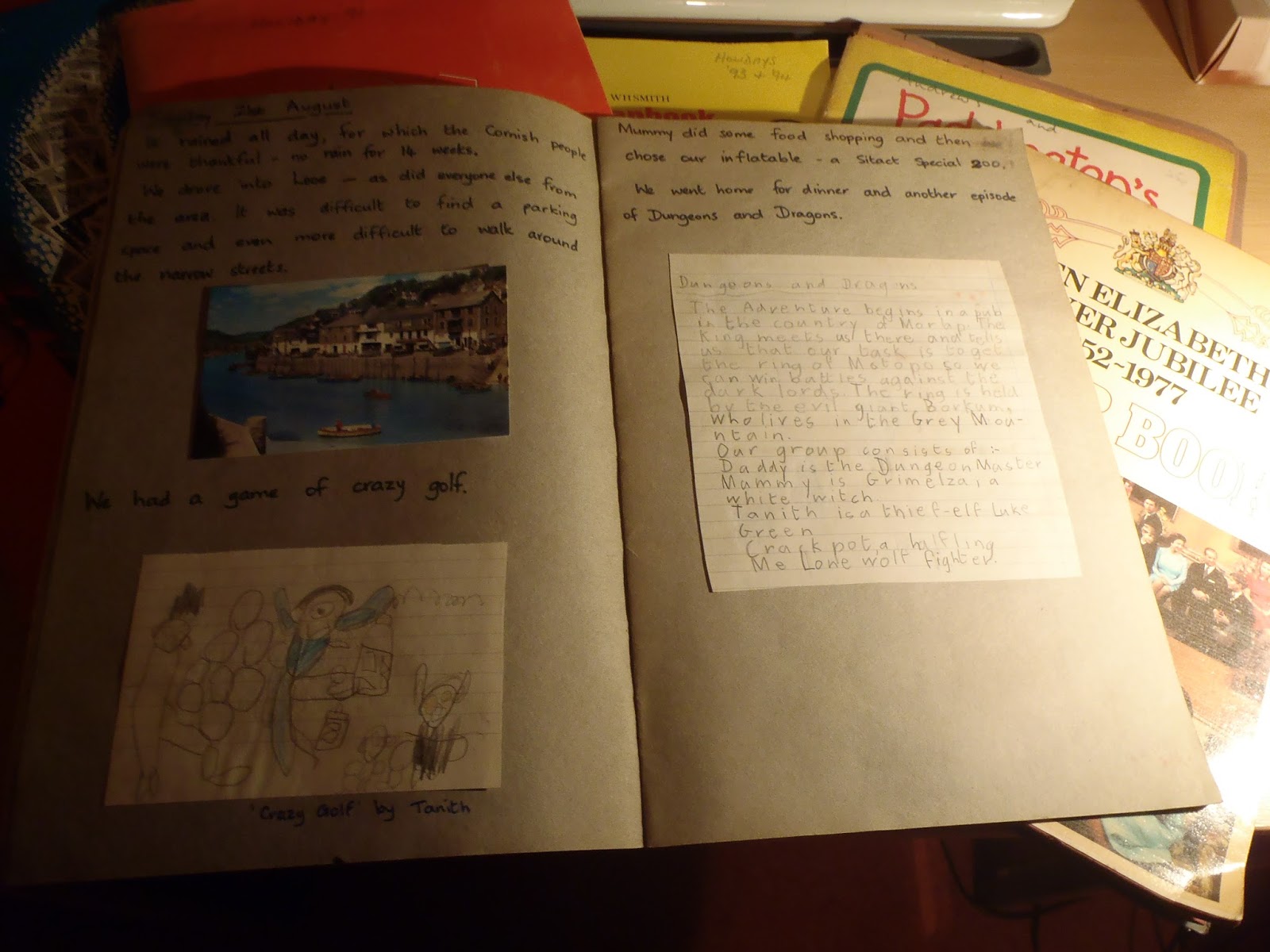
This is a book from a holiday in Cornwall in 1984 when Andrew was 7 and Tanith 4 (and a half!) Andrew wrote about the game we played in the evening:
and Tanith drew a picture of the game of crazy golf we'd had:
One morning, my husband found a dormouse when he was on his early morning run and woke the children to admire it before returning it to the bushes:
Do you remember those long country walks I shared with you some time ago? The scrapbook from our Easter holiday in 1986 gives my account of one, alongside  my husband's illustration:


Now I remember why my son and daughter groan whenever LCWs are suggested! It is good to have these prompts to take us back to happy times. I am grateful to those families who took the trouble to fill in the diaries at Ham Farm, their memories are now part of the history of that time and place.

Saturday, February 16, 2013

The winner

Thank you to everyone who entered the draw for Slightly Foxed Quarterly. Fifteen names went into the hat yesterday and the one that came out was Derwena. Congratulations! Please send me your details via email and I will set up the account in time for you to receive the Spring edition.

Thursday, February 14, 2013

Last day for Slightly Foxed draw

I'm in the midst of the grandchildren for half term but I'll be leaving for home tomorrow. Before I set out I will put the names of everyone who has left a comment here in the past two weeks into a hat and let one of the children draw one out to win the subscription for a year of Slightly Foxed quarterly.  If you have been hovering and would still like to enter then please do so today.

Good luck!

Saturday, February 02, 2013

Birthday book draw

To celebrate the seventh birthday of Random Distractions and to thank readers, commenters and lurkers for your friendship, interest and support I would like to offer the chance to win a year's subscription to the Slightly Foxed Quarterly.

I wrote something about Slightly Foxed in my last post and the winner of the subscription could read the rest of that article by Roger Jones plus lots of other fascinating insights into literary treasures. I love the four days every year when my copy lands on the doormat. It is a beautifully presented magazine, small enough to fit in your handbag so ideal for a bus or train journey or a visit to the dentist. The articles are short enough to read over a cup of coffee but long enough to satisfy the book lover's curiosity. I have been reminded of many old favourites, introduced to authors and titles I had overlooked and sent scurrying to long neglected shelves and to second-hand book sellers to find the treasures that Slightly Foxed has displayed to tempt me.


I don't have a vested financial interest, I just love sharing my favourite publication,  but I must declare a personal interest in the next edition, Spring 2013, because it will contain a review of J.P. Donleavy's work by my son!

If you would like a chance to win a one year subscription (4 editions), leave a comment below. I hope all my old friends will enter (if only the pension would allow me to send each of you a subscription!) but I also welcome new readers, casual readers and those who often come by but never leave a comment. Just say, "Hi. Count me in." and I'll do that. The magazine can be delivered anywhere in the world.

I am sorry that a recent influx of Spam has forced me to stop accepting comments from people who prefer to remain anonymous. You can still enter the draw by sending me an email to the address at the top of the blog.

I will make the draw on Friday 15 February. Good luck!

Friday, January 18, 2013

The winner is ......

Thank you to those who entered the bookdraw. I duly put the names into a hat and drew out
So, Margaret, if you would like to email me at monix123@gmail.com with your details, I will be happy to send you A Kettle of Fish. I do hope that you will enjoy it.
Maureen

Friday, January 11, 2013

A fine kettle of fish

My first read of 2013 was A Kettle of Fish by Ali Bacon. I have a paperback copy, kindly sent by Ali, but it is also available in Kindle format on Amazon.

The first thing to note about the book is its  cover, it has a pleasant, tactile quality and a striking design. Few writers get to choose the cover design for their work but in this case the designer is  Ali's daughter, Ellie.The cover is stylish and it actually represents elements of the story, such a rare occurrence in modern novels, I find.
I knew that the writing would be good: I have been a follower of Ali's blog, Between the Lines for a long time and I have also read some of her short stories. I wasn't sure that I would enjoy the subject matter though: a young Scottish girl with a troubled background embarking on her adult life with more than the usual number of questions and challenges to face. But I was hooked from the start and I found myself abandoning the post-Christmas clearing up in order to escape to a quiet place to finish reading the book.

Ailsa has just left school and should be heading for the Highlands with her friend, Faye, to enjoy working on a summer camp before starting her first term at Edinburgh University. Fate intervenes when Ailsa's mother develops one of her mysterious bouts of illness and Ailsa reluctantly decides not only to miss the summer trip but also to live at home and commute to Edinburgh instead of sharing student accommodation with Faye.

Ailsa's mother asks her to buy some fish for supper and that is the beginning of  the fishy metaphor that is cleverly sustained throughout the novel.  More than one 'kettle of fish' is stirred up when Ailsa meets up with the fishmonger's son and embarks on an impulsive, unsatisfactory romance. Ian introduces her to his friend Andy and a series of coincidences that set her on the search for the truth about her absent father.

There are lots of strands to this story, lots of twists and turns and surprises. I found I was very willing to suspend my disbelief at the number of coincidences that led to the unravelling of the mysteries because it is a good story, told convincingly. The portrayal of Ailsa as an intelligent, strong and yet vulnerable girl, getting into scrapes but managing to avoid disaster is very realistic. Many of the situations she finds herself in stir long-forgotten memories of first encounters with teenage boys, alcohol, unsuitable older men, leaving home and having to make life-changing decisions. Anyone who went straight from school to college will identify with this.

The writing is  lively and energetic, there is lots of action but there is also sensitivity and wisdom in the observation of the characters. I don't want to give any spoilers, you must read the book to discover the surprising truth about Ailsa's parents. It is a good book to start the year.

I have one copy of A Kettle of Fish to give away. Leave a comment here before Friday 18 January if you would like to win it. I will post it anywhere in the world. Good luck!

Saturday, March 03, 2012

Book winner

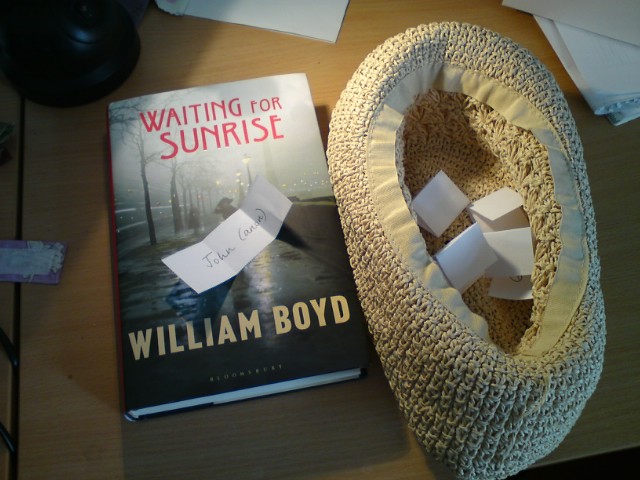
Seven names went into the hat and out came that of Anonymous, who happens to be my brother John.  

You can collect the book when you come for your next visit to Devon - there's an incentive for you!

Friday, March 02, 2012

Book draw reminder - Waiting for Sunrise

I have retrieved my hat from granddaughter Millie and will be using it tomorrow to draw a name out  for the copy of William Boyd's Waiting for Sunrise. You can read my review of it here on The Dabbler. I promise that my reviews never contain spoilers! If you would like a chance to win my copy then leave a comment below.

You could also  win a copy by signing up for The Dabbler Book Club. It is free and offers lots of interesting new releases to members.

Good luck, everyone.

Friday, February 24, 2012

Waiting for Sunrise - book draw

William Boyd's Waiting for Sunrise  is one of the most beautifully written modern novels that I have had the pleasure of reading. You can read my review of it on The Dabbler


If you would like a chance to win my copy, then leave a comment here on this post and I will draw a name at the end of next week. If you want to increase your chances of winning,  there are two more copies available on The Dabbler. There are always free books available there for readers who join the book club so why not join now? Happy reading!
 

Thursday, February 02, 2012

A winner

With only two entries in the book draw, I thought the best way to decide on the winner would be to toss a coin. Cath and Cathy - nothing between them but a y and a few thousand miles. Cath gets the head:
 and Cathy the tail:
 Excuse me for a moment while I flip the coin ...............................

It's heads and the winner is ........ CATH

Please send me your postal details to the email at the top of the blog, Cath. I hope you enjoy the book.

Tuesday, January 31, 2012

Book draw reminder

Calling all lovers of fantasy, mystery and thriller writing: if you would like the chance to win a handsome copy of 77 Shadow Street by Dean Koontz, then leave a comment here or on the previous post. I will post it anywhere in the world. The draw will take place on Thursday 3 February so hurry!

Wednesday, January 25, 2012

Book giveaway

Publishers HarperCollins have kindly sent a copy of 77 Shadow Street by Dean Koontz to be given away on Random Distractions. I am not the best person to offer a review of this book because I don't usually read science fiction, fantasy or horror stories and this book contains all of those elements. But I did read it and will say a few words about it, making no claims to do justice to what I am sure is an excellent example of this genre of fiction. I must say that I soon began to enjoy it and I could  be heading to the library, in the near future, to see if they have any other books by Dean Koontz

Author:    Dean Koontz
Published by Harper Collins   in January 2012
451 pages
Price £18.99

Shadow Hill is the highest point in an unidentified heartland city. The hill and Shadow Street that was built on it were so named because of the shadows of trees and buildings that were cast on sunny afternoons, creeping up the hill as evening progressed until they met the night at the summit.

Number 77 Shadow Street was built in 1889, the very grand home of billionaire Andrew North Pendleton. At that time, the house was  called Belle Vista, and the Pendleton family - Andrew, his wife Margaret and their two young children - lived there happily until tragedy struck in 1897. Margaret and the children disappeared. It was presumed that they had been abducted but they were never found; Andrew became an eccentric recluse and eventually committed suicide. Therein lies the first mystery connected with the house.


The next owner of Belle Vista was Gifford Ostock, who lived there between 1905 and 1935. One night in December 1935, the butler slaughtered the whole family and all of the live-in staff before killing himself. The butler left an incoherent note claiming to have killed them all in order "to save the world from eternal darkness." Although sixteen people died, only eight bodies were found.


The house was owned next by Harmon Firestone, who died peacefully in his sleep in 1972. Belle Vista was then purchased for development into twenty-three luxury apartments but the conversion work was disrupted a year later, when a number of the tradesmen and craftsmen working there left their jobs because of strange happenings which they refused to discuss.  The apartments were eventually completed and the building renamed as the Pendleton, the most exclusive set of apartments in the town.

For more than thirty years, the Pendleton has been a peaceful and luxurious home to the wealthy, some famous, some infamous and some simply hard-working or fortunate enough to be able to afford to live there. It is now December 2011 and the peace is beginning to be disturbed. There are strange noises and glimpses of ghostly figures, the walls seem to be alive and there are menacing rumblings from deep inside the hill below the Pendleton.


Silas Kingsley lives in apartment  3-C. He has spent his years of retirement studying the history of Belle Vista/the Pendleton. He has noticed a link between the mysterious events of the past: they have occurred every 38 years and the last known incident was in 1973, exactly 38 years ago. He realises that the odd things that are happening in the building now are leading to some terrible tragedy unless he can unravel the mystery in time and save the residents.


To find out about the other residents and what happens to them, to be led into the mystery of 77 Shadow Street and the horrors awaiting them and the rest of the world you must read the book. It is a gripping read and I advise you to keep the lights on and to beware of shadows. You could buy a copy from Amazon or download it to your Kindle or you could leave a comment here and have a chance to win a copy.

You don't have to be a fantasy or science fiction lover to enjoy 77 Shadow Street. And you don't have to be a regular reader here to enter the book draw. Just leave a comment, saying that you would like to enter and I will draw a winner on Wednesday 4 February.

Tuesday, January 24, 2012

A scary story

Granddaughter Amelia, known as Millie, is now three and a very important three-quarters years old. Like all members of our family, she loves books and she is beginning to read and write independently but her skills can't yet keep pace with her imagination and desperate need to communicate. Mummy is frequently called on, therefore, to act as her amanuensis when Millie wants to dictate a story.

This morning, the postman brought her latest masterpiece, addressed to Grumpy, the grandchildren's name for my husband. First, the accompanying card:
 And now for the story. Be warned that Millie is no sugar and spice child. She likes her stories to have a touch of drama and sometimes quite shocking endings!
 We are building a collection of her work as an investment for our future. When Millie is an established novelist, we will cash in on her "early work."

Wednesday, January 11, 2012

Perfecting my punctuation

I have to admit to being something of a punctuation bore. I tut when I see a misused apostrophe or hyphen, I like to use colons and semicolons and yes, I punctuate my text messages. I know that there are many fellow sufferers out there, risking stomach ulcers and anxiety attacks on every trip to the local shopping centre. I bet we each own a copy of Lynne Truss's Eats, Shoots and Leaves and I also bet that most of us are past the first flush of youth, having benefited from a good grounding in English grammar at school.

While this is a subject very close to my heart, I have resisted writing about it for fear of making some glaring error and having ridicule heaped upon me by my discerning readers! I know that I don't know everything but I don't know what I don't know. However, I have just received a book to review that is about to change all that and I wish I could afford to buy a copy for everyone who loves the English language.


Can You Eat, Shoot and Leave? by Clare Dignall is a must-have book for everyone: from the reader or writer with a good grasp of punctuation to the poor soul who went to school in the last twenty years and has never heard of it.  It is as entertaining as it is informative and is available from Amazon.

There is a brilliantly funny foreword by Lynn Truss and then the book begins with a light-hearted quiz to establish the reader's level of competence in matters of punctuation. I turned out to be someone with a  grasp of how punctuation works but with a few obsessive tendencies. There does, however, appear to be hope for me if I persevere with the exercises. 


Each chapter deals with a specific point: the apostrophe, the comma, the colon and semicolon; then on to expressive marks - the exclamation mark, question mark, quotation marks, italics, dashes, brackets and the ellipsis - and, finally, the hyphen. Everything is presented in a clear and simple way with lots of humour.  Michael Gove could improve education standards overnight by appointing Clare Dignall as chief advisor to schools! 


I didn't make 100% in the exercises but I learned quite a lot, including some interesting differences between punctuation in UK English and US English. I haven't mastered all my new-found knowledge yet but I have my copy of Can You Eat, Shoot and Leave? right here beside my laptop and it will soon be well-thumbed. I see it is advertised as a Workbook, meaning that we are expected to write in it but that would upset my equilibrium too much! 


Watch out! The Panda could be heading your way to give you a punctuation workout.


Tuesday, November 22, 2011

The lost art of waiting

As I will be away for the first week of Advent, I thought I would dig out a post I wrote a couple of years ago. Not much has changed: my friend, D and I still brave the perils of the Link road to visit each other and we are all still too busy for our own good! I will be taking the Paula Gooder book with me and hope to havea little time to spend in contemplating its wisdom. 

So, here's one I wrote earlier, in 2009

Tomorrow I'm going to visit my dear friend D of 60 going on 16. I live in North Devon, which is connected to the Rest of the World by the notorious North Devon Link Road. D lives just across the border, in the Rest of the World so, dear reader, I will be taking my life in my hands for the sake of friendship, just as D does when she comes to visit me.

The Link Road was built in the late 1980s to divert the ever-increasing holiday traffic from the villages along the old A398 route to the coast. The planners did not take into account the fact that a faster road would attract even more traffic and they built a wide single carriage road instead of a decent dual carriageway. In consequence, instead of a pleasurable drive through some stunning farm and moorland scenery, one risks life and limb amid the boy racers and impatient business men and women who aim to get from Barnstaple to Tiverton in record time.

I used to drive this route several times a week and frequently had to pull onto the hard shoulder to avoid a head-on collision with someone doing a reckless overtake in the other direction. Road blocks, diversions and piles of floral tributes are frequent reminders of lives lost and families devastated by moments of careless impatience. One traffic policeman told me that the maximum time that can be gained by driving faster than the 60mph speed limit on that road is 10 minutes. J Alfred Prufrock  measured out his life with coffee spoons, that seems to me a less trivial epitaph than 'I traded 50 years of my life to save 10 minutes.'

This sombre and rambling preamble is leading to an explanation for my recent absence from the blogging scene! My internet connection was intermittent during the recent stormy weather but that, I hope, is now passing. What has really kept me away from the keyboard is this book:
The Meaning is in the Waiting
The Spirit of Advent
by Paula Gooder


It is one of the books that I took to Spain and I used it for my daily reflection. In it, Paula Gooder sets out to "stimulate you to think a little more about waiting: why we do it, what it feels like to be someone who waits, what happens when we don't wait and why God might want us to get better at it." She doesn't offer answers but opens up questions and suggests new ways of looking at things.

I was so inspired by the book that I used it as the basis for an Advent preparation day that I was organising for my parish. While the religious context is obvious, everyone who attended on Saturday agreed that the ideas were relevant to all areas of life and that our impatient society would benefit from rediscovering the art of waiting. (If anyone would like a copy of the study notes that I prepared, I would be happy to send them as a Word document email attachment or to mail them.)

The title, The meaning is in the waiting, is taken from the poem Kneeling by the poet-priest R. S. Thomas. When the group I led began to think about major events in their lives, they were able to see how true this was: the preparation and anticipation of a wedding, a birth or a visit can hold more meaning for us than the actual event, which can seem like an anti-climax, lost in a frenzy of activity. This can be especially true of Christmas Day when getting the house ready, shopping and cooking can leave us too exhausted to appreciate the day itself. The whole of December can be lost in frantic, bustling preparation or it can be a time of active, productive waiting.

Advent is a paradox: we wait for an event that has already happened. I fear that we are losing our sense of awe and wonder and our ability to accept and appreciate mystery. I can live very happily with paradox, I don't want the whole of life to be rationalised but I do appreciate the way that Paula Gooder presents us with a way of seeing the  waiting that connects the past, the end times and the present. This is one of those rare books that I have encountered in my life that leaves me feeling that I may not understand something but I somehow know it.

She uses another piece of poetry, from Elizabeth Barrett Browning's Aurora Leigh:
Earth's crammed with heaven,
and every common bush afire with God;
But only he who sees, takes off his shoes -
The rest sit round it and pluck blackberries.
She has convinced me that I want to spend Advent without my shoes, appreciating the opportunity to wait in hope and thoughtful anticipation so that, come Christmas, those blackberries or, more likely cranberries, will taste the sweeter.

Here is a gift I had from the longest-serving friend of my youth. It is a rare image of the pregnant Mary, from a 14th century wall painting; a true picture of waiting in joyful hope:
I will be using this, alongside the Advent wreath, to aid my Advent reflections.

Tuesday, August 30, 2011

Quick, save a blog!

I have only recently discovered Tracey Woods' blog, after she left a comment here. It seems that she is already thinking of giving up because she hasn't  yet gained the readership she hoped to get. Please go over and encourage her. We all remember those early days when nothing happens. You could even win a copy of one of her books. Do go there, now. Please.


And if you are interested in books you might like to see what's on offer at The Dabbler right now. Not  only can you join the book club and have the chance of drawing a free book each month, you can also sign up to be a reviewer and choose books as and when you wish. For more details click here.

Monday, July 11, 2011

Flesh and Grass

 
 Flesh and Grass 
Author:               Libby Cone
Publisher           Createspace (June 2011)
Paperback         174 pages
Available from Amazon

This is an historical novel, based loosely on the story of the ill-fated Plockhoy settlement in Delaware.

It is 1699 in Germantown, Pennsylvania and Cornelis Boom sits reminiscing about his arrival  in the New World more than 35 years earlier. He recalls the people he travelled with, their hopes and fears, the successes of their first year and the tragedies that were to follow.

Just as in her first novel, War on the Margins, Libby Cone has chosen to write about a small, tightly-knit community that becomes overwhelmed by outside forces and events. Once again, her research is meticulous and the fine detail of everyday life transports the reader to the very heart of that community.

Cornelis recalls how his father, Pieter Cornelissoon Boom set sail from Amsterdam in 1633 with his family and a small group of fellow Collegiants, to establish a Mennonite Commonwealth in Delaware Bay. He describes the difficult voyage and the establishment of the small colony in Swanendael in the Dutch-held territory of the New Netherlands.

Hard work, determination and a strong sense of community, based on their shared faith, lead to the successful establishment of the tiny commonwealth. But peace and prosperity are short lived.  The bay is subjected to frequent raids by pirates, who plunder and destroy the settlers' crops.  Worse is to come as the economic rivalry between England and Holland develops into war;  the settlers become victims of violent clashes between the two factions and the colony is destroyed.

This is a very absorbing story with the tensions greatly enhanced by the choice of Cornelis as narrator. Not only is he a young boy, with limited understanding of what is happening around him but he is also blind. Situations that fill everyone with dread are even more terrifying for him. His recollections in adulthood are not of things he witnessed but of what he experienced through his other senses, most vividly through his sense of smell. He is haunted by the scents of sweet grass and burnt flesh.

A first person narrative has inevitable limitations. We can only learn what Cornelis is able to tell us and his observations are limited by his blindness and his youth. I wanted to know more about the characters and what happened next. I suppose all good stories leave us wanting more and Flesh and Grass has already led me to find out more about the Plockhoy settlement and, just in case Libby isn't planning to write a sequel about Cornelis' life in Pennsylvania, I will be reading about the Mennonite settlements there, too.

This is an excellent read and I highly recommend it.

Tuesday, May 03, 2011

A whistle-stop tour of German history

A few weeks ago, I signed up to The Dabbler Book Club and received a copy of Germania by Simon Winder.
Simon Winder works in publishing and has spent many years editing history books. His vast knowledge of European history is apparent in this lively and witty romp through centuries of battles, alliances, betrayals, marriages and treaties. If, however, you are hoping for a better understanding of  The Holy Roman Empire, the Prince Electors and Dukes, the Thirty Years War, the Congress of Vienna and various Diets that peppered your history lessons, you will be disappointed. Germania is Simon Winder's Personal History of Germans Ancient and Modern, it will keep you entertained but leave you as confused as ever. 

In 441 pages (about 90 too many for comfort), we are taken to most of the former states, dukedoms and principalities of pre-unified Germany to see ugly statues and dull museum pieces, mementos of long forgotten battles, heroes and villains. They are described with great enthusiasm and irreverent humour but there are rather too many museums, schlosser and memorials for even this lover of absurdities.

How I wish, though, that this book had been around when I had to write an essay on Catherine the Great, if only my history teacher had possessed a sense of humour!

In a sort of asteroid belt of low-grade German princesses and narrow, petty, moustachioed princes there was enough room for something really surprising to happen. Most absolutely alarming in this respect was pretty little Sophie Augusta Frederica of the laughable territory of Anhalt-Zerbst, a place so small it  could hardly breathe. Her father was a Prussian field marshal and as a helpless pawn in plans to boost Prussian-Russian relations in the 1740s Sophie was shunted off to Russia where, after several ups and downs, she married the Grand Duke Peter, learned Russian, became Russian Orthodox, had Peter killed and wound up as Catherine the Great, devastating the Ottomans, the Swedes and the Poles and carving out immense new territories from Latvia to the Crimea. Indeed, a case could be made for her being the single most successful German ruler of all time, albeit not one ruling Germany.

There are many such amusing cameos to lighten what might otherwise be a depressing catalogue of wars and cruelties of various kinds. There is an extensive bibliography should you wish to take a more serious look at German history but this book is an idiosyncratic, high-speed tour around Germany, pausing to look at oddities that perhaps give some insight into the nature of the German people. An interesting and entertaining read.

For reviews of Germania by Simon Winder go to The Dabbler. And why not join the book club?

Wednesday, February 16, 2011

South Riding by Winifred Holtby

South Riding
Author  Winifred Holtby
First published 1936
Paperback 544 pages

This reissue of Winifred Holtby's classic novel anticipates a new Andrew Davies television adaptation to be broadcast soon on BBC One. The trailers promise BBC drama at its best but I recommend that you rush out and beg, borrow or buy a copy of the book before it gets to the screen. Don't be put off by the 544 pages, it is such an absorbing story with such varied, realistic characters that I found myself staying up late into the night to read just one more chapter and then one more....

South Riding. An English Landscape is set in the fictional district of the South Riding of Yorkshire in the early 1930s, a period overshadowed by the impact of the Great War and the Depression. It is a period of change and resistance to change. There are those who want better living and working conditions for the working classes: better education, housing, health care and more opportunities for girls to fulfil their potential. On the other side are those who want the old traditions to continue, with a social hierarchy based on land ownership and loyalty. These issues will be decided by members of the local council, each of whom brings his or her own passions and interests to the council chamber.


The two conflicting views are represented by Sarah Burton, the feminist, liberal, young headmistress of the girls' school and Robert Carne, the gentleman farmer of the centuries old Maythorpe Hall who is passionate about his farm, his horses and his loyal tenants and labourers. Their stormy relationship has been likened to that of Mr Rochester and Jane Eyre but South Riding is far more than the unfolding of an unlikely love story, it is a complex work of social history, idealism, heroism and suffering.


The book begins with a list of Characters in their order of appearance that runs to six pages. It is a measure of Winifred Holtby's skill as a writer, as well as her compassion for and understanding of people and their concerns, that each character is fully rounded and memorable. There are no simple heroes and villains, every good person has some flaw, frailty or blind spot and every scoundrel has at least one redeeming feature.


The members of the South Riding County Council are a motley crew, some of whom seek to serve their local community while others use their position to further their own interests. They have limited funds to allocate and must balance the needs of specific groups, such as the unemployed and the slum dwellers, against investment in commercial interests that would benefit the area as a whole. Plus ça change!


South Riding is considered to be Winifred Holtby's masterpiece. It was published a year after her untimely death at the age of 37. It is beautifully written and totally absorbing. The landscape is as much a central character as Sarah Burton, Richard Carne, Alderman Mrs Beddows and Lydia Holly, the 14 year old girl from the Shacks who wins a scholarship to the High School. It encompasses her passion for education, social justice and feminism. It is as relevant today as it was in 1937.

Sunday, February 06, 2011

Washing lines#3

I've just been reading about Victorian wash days. I was surprised to find that these were not weekly events but probably only took place about once a month. When I read the instructions for landering in the Girls' Own Paper of 1899, I understood why ordinary housewives, who had no servants to do the work,  would need time to recover in between what were wash weeks rather than days:
Monday - Steeping (soaking)
Tuesday - Washing
Wednesday - Folding and Starching
Thursday - Ironing
Friday - Airing

 Have you noticed that there is no mention of drying? Surely that should follow the starching?  I could easily become distracted at this point and explore the culture of washing or ironing the laundry but I am supposed to be writing about washing lines, so I will not digress.

I like a neat and orderly washing line. The sheets, pillow cases and duvet covers go out first thing in the morning so that they are usually dry when the towels, tea cloths, table cloths and napkins are ready to hang out. Nowadays, thank goodness, I don't have rows of shirts on the line but when I did, they were pegged at the tail. Dark coloured items next and, if it is a really warm and windy day and I can get everything dried outdoors, the socks are pegged by the toe, in pairs. Oh, and in case you are wondering, trousers and skirts are pegged at the waistband. I am afraid that the Random Distractions washing line has nothing random about it!


Now for that rather special line that I mentioned in my last post:
 I bought this Picture Puffin book in 1967 to use with my first primary school class. It has delighted many children, especially my deaf pupils who always loved stories with a strong visual element. My own children loved it and now Millie and Charlotte have been introduced to it.

Farmer's wife, Mrs Mopple hangs her washing out to dry, using good old-fashioned dolly pegs, but the wind blows each item off the line and onto one of the farm animals so that when she comes to collect her laundry she finds:
A pig in a petticoat
A turkey in a nightcap
A chicken in a muffler
A jersey cow with ten horns
A rabbit with the measles

That would never happen if she used a tumble dryer now would it?